


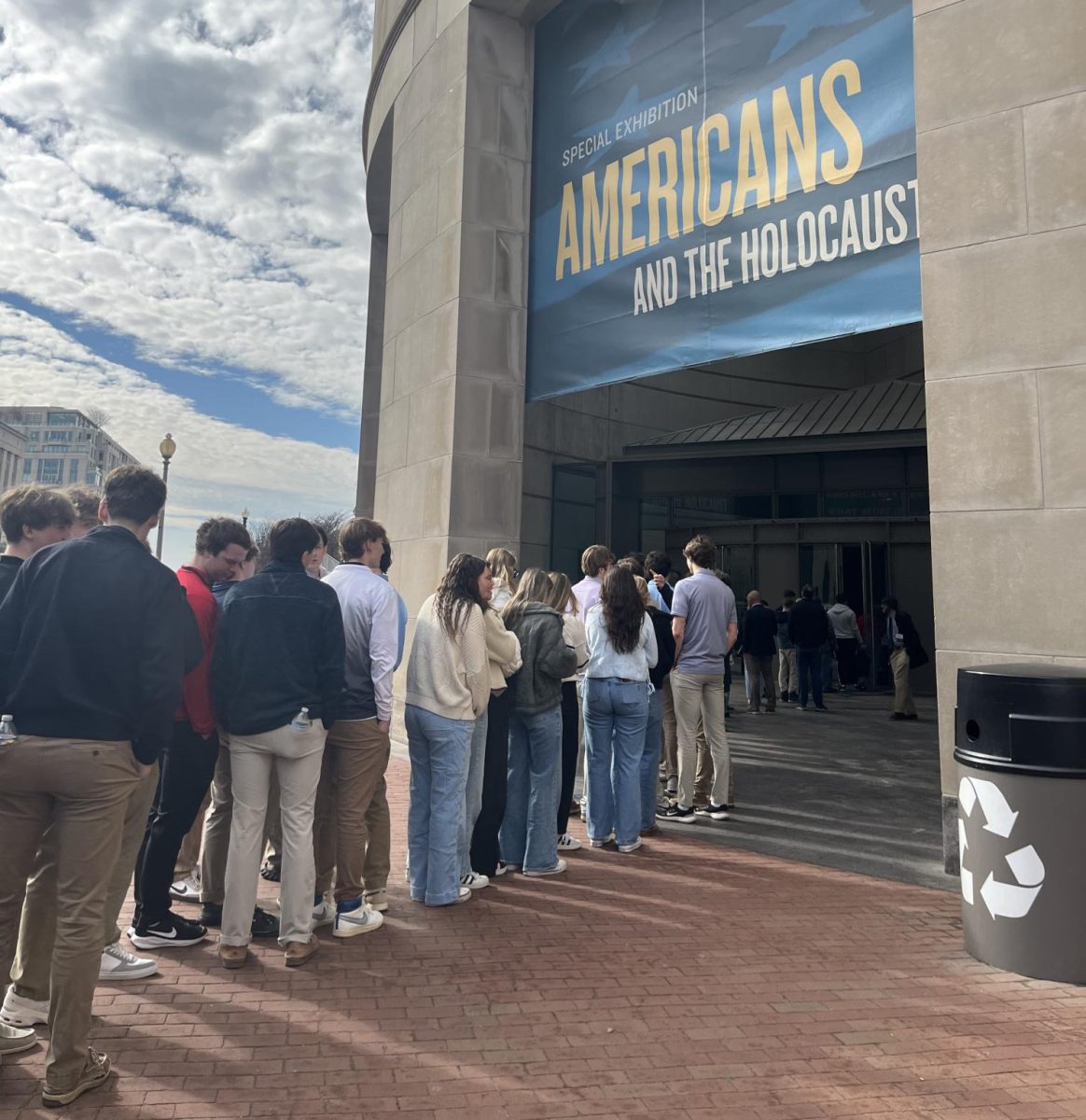
Every year, seniors take a trip to Washington, D.C. to visit the National Holocaust Museum and Arlington National Cemetery. On the morning of February 25, the class of 2025 embarked on their journey.
This trip was sponsored by the Klein family and was set up by Academics Project Manager Louise Geczy and the administration.
On the bus, students were provided Pop Tarts and granola bars for breakfast and Doritos and pretzels for a snack in the afternoon. They were also given water for the trip up and back.
Before the trip, students learned more about the Holocaust and Arlington National Cemetery in their Patriot Pathways and English classes.
Mrs. Geczy said that it was important for students to learn about the places and what they represent before the trip. She believes the more prepared students are, the more value they will get out of the experience.
Seniors were required to attend this trip as a graduation requirement. This trip also ties into their senior year English classes. Each level of English, AP through college preparatory, reads the book Night by Elie Wiesel, a personal memoir of Wiesel’s time in Auschwitz during WWII when he was just a teenager.
This trip is an integral part of the JC mission because it lets students focus on the exploration of human rights. It also allows seniors to get a better view of firsthand experiences of a major human rights violation as six million Jews died in the Holocaust.
Students departed from JC at 7:00 am. They first visited the Holocaust Museum where they had two and a half hours to explore all the exhibits. For many, this part of the trip can be very emotional and upsetting.
After the museum, students were taken to the Pentagon City Mall for lunch. Here they had a little more than an hour to eat and explore the shops.
Senior Claire Moffitt said, “There was good food; it was fun to shop and hang out with friends after an emotional morning.
After lunch, students got back on the bus for their short trek to Arlington National Cemetery.
At Arlington National Cemetery students watched the Changing of the Guard at the Tomb of the Unknown Soldier and watched the Wreath Laying Ceremony.
During the wreath laying ceremony, seniors Katie Cushing, Ellery Shertzer, Sydney Field, and Connor Lloyd all had the honor of participating.
After the ceremony, students had a little bit more time to explore the cemetery before they had to return to the buses for the ride home.
At the cemetery, they were able to visit famous gravesites like President John F. Kennedy and his wife Jacqueline as well as President William Howard Taft. They could also visit memorials to the Coast Guard and the Space Shuttle Challenger, among others.
Students got back to JC at approximately 7:00 pm.
The next week in school, seniors had to write reflections on their experiences for their Patriot Pathways class.
Mrs. Geczy said her favorite part of it all is “reading the reflections seniors wrote post-trip and finding out what they were moved by.”
Sammie Bender reflected on her time at the museum and said her favorite part was “bonding with my classmates and learning more about the Holocaust.”
One thing that she said that she learned on this trip was about all the hardships and pain the Jewish people went through.
What will you remember the most about your senior trip?
Leah Ruffatt: “The lights representing all the children who died because it’s hard for me to imagine that large number in my head. When I saw all the lights, the visual was shocking to see that amount of lights right in front of me, and with that just being the number of children really put into perspective how many people were killed.”
Annie Minoglio: “The shoes. Knowing that real people who once lived as I do walked and lived their lives in those shoes was extremely heartbreaking.”
Elizabeth Hughes: “The 3-D model of the gas chambers with people in them because their faces trying to escape the chamber was very eerie; they knew this was their final moment.”
Emmerson King: “The videos of how they would dispose of their bodies because it was just like shocking. Yes, I, knew it was real, but it brought the whole thing to life for me.”
Addy Carter: “The videos because I didn’t know they did experiments on people, too, and it was graphic, which showed me the reality of it.”
Aeden Gilbert: “The real shoes of the people killed because I felt sad that those were real, and all those people died.”
Jackson Harcarik: “The wall of people affected; it was so powerful to see how many people were involved even when it showed just a tiny amount of the real number.”
Luca D’Alessandro: “Seeing the conditions that they lived in at the concentration camps showed me how hard it was to get through each day.”
Gianna DeBrigida: “The room with the dot lights that represented a death for each child in the Holocaust because it struck me that kids my age and even younger weren’t given a chance to live.”
Ryan Pindell: “I’ll remember the Changing of the Guard ceremony because it meant a lot to me since I have multiple people in my family who are involved in the military.”
Samko Duracka: “The shoes because there were people who wore those shoes, and each shoe was a life.”
Makayla Casey: “Something that stuck out to me on the trip was the mass amount of photos on the wall displayed in the museum. It really struck me to see a visual of how many people had truly passed and what their lives were like before the Holocaust.”